
Hospital kitchens under pressure: How digital temperature monitoring enhances patient safety
In hospital kitchens, hygiene regulations, time pressure, and high responsibility all come together. That’s precisely where continuous temperature monitoring delivers a clear operational and hygiene advantage.
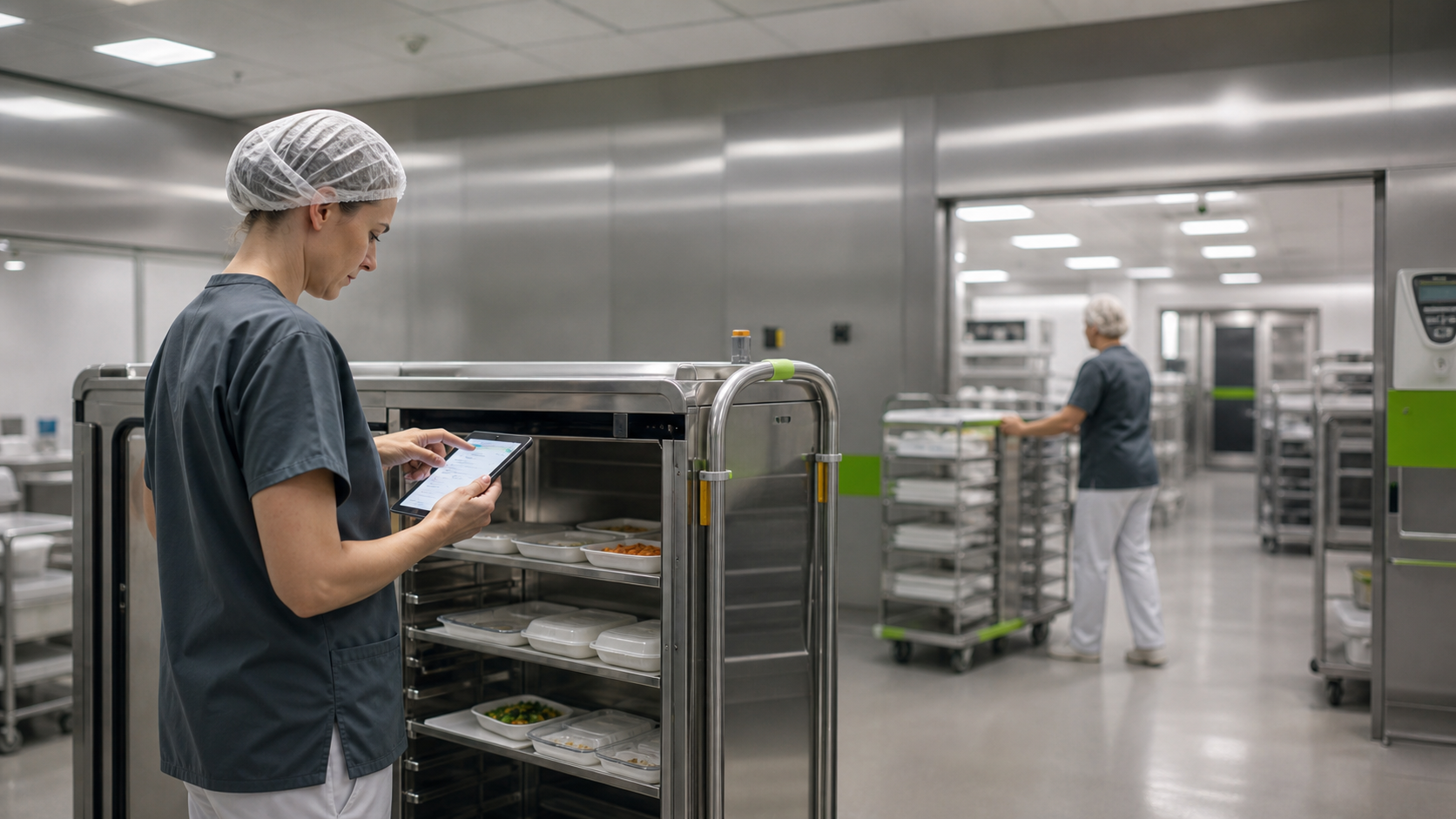

Why hospital kitchens have different requirements
Hospital kitchens operate under conditions that differ significantly from many other large-scale kitchens. They serve people whose immune systems may be weakened by illness, surgery, or therapy. What might be a minor deviation in a staff canteen can pose a real risk in a clinical setting. As a result, the demands on hygiene, traceability, and reliability in meal provision are exceptionally high.
At the same time, these kitchens work under considerable time pressure. Fixed mealtimes apply, multiple dietary requirements must be produced in parallel, and special requests for medical reasons are more the rule than the exception. Dietary cuisine, allergen management, and textures for patients with swallowing disorders add to the standard HACCP obligations. Employees carry significant responsibility within a tightly scheduled process.
In this complex environment, hygiene regulations, time pressure, and high responsibility all come together. Manual checks with pen and clipboard reach their limits here, as they are time-consuming and only provide snapshots. This is where continuous temperature monitoring makes a difference: it creates an objective, gap-free foundation instead of manually recording individual measurements throughout the day.
How digital monitoring supports daily hospital routines
In day-to-day clinical operations, critical points arise wherever temperatures need to be maintained over extended periods without someone constantly present. Cold storage rooms, freezer cells, refrigerators for sensitive food items, and temperature-controlled holding or regeneration are classic examples. Continuous monitoring covers these areas around the clock, revealing trends that would go unnoticed with spot checks.
The practical benefit lies primarily in decoupling presence from control. At night, on weekends, or during particularly busy periods, no one needs to make extra rounds to record values. Sensors automatically capture measurements, and in case of deviations, an alert can be sent to the responsible employees. A system like Kibi Scada consolidates such data from any manufacturer on a single platform, keeping different devices and locations centrally visible.
What matters is the solution-oriented nature of this data. The goal is not to monitor people, but to reliably observe equipment and processes. Employees receive a tool that takes routine work off their hands and notifies them precisely when intervention is truly needed.
Keeping track of cold chains and regeneration
A large portion of hospital catering today follows processes like cook-and-chill, where meals are pre-produced, rapidly chilled, stored, and later regenerated. While these processes offer organizational benefits, they place high demands on maintaining an uninterrupted cold chain. Every step—from rapid chilling to cold storage and reheating—must take place within defined temperature ranges.
Continuous measurement makes the most vulnerable transitions in practice transparent. If the temperature doesn’t drop quickly enough during chilling, or if the required core temperature isn’t reliably reached during regeneration, this can be traced through the recorded data. This provides a clear picture of whether the cold chain was truly maintained, rather than relying on isolated, manually recorded values.
For those responsible, this means greater security in a critical process. Deviations aren’t only detected during the next inspection but can be identified and assessed early on. This reduces the likelihood of having to discard an entire batch while also supporting the hygienic quality of the meals served.
Food distribution and transport routes to the ward
In hospitals, the kitchen’s responsibility doesn’t end at the serving counter. Meals often travel long distances—from production areas through distribution kitchens to individual wards. Meal distribution trolleys, long corridors, and waiting times before serving can cause hot dishes to cool down or cold items to warm up before reaching patients.
This final stretch is particularly difficult to monitor with manual checks, as it’s spread out and hard to access. A systematic temperature measurement at key points helps identify critical transitions and allows for targeted evaluation of transport routes and processes. This makes it possible to spot whether certain wards, times of day, or routes consistently show issues.
These insights provide concrete starting points for improvements. Perhaps a route needs adjusting, a handover needs tighter scheduling, or temperature retention at a specific point needs stabilizing. What matters is that the data provides an objective basis—eliminating the need to rely on assumptions about the causes of complaints.
Patient safety starts with early detection of deviations
Patient safety isn’t achieved through a single measure, but through many reliable small steps. Detecting temperature deviations early is one of them. When a cooling unit gradually loses performance or a door hasn’t been properly closed overnight, this often shows in the measurement trends before a critical point is reached. This gives you time to respond calmly and thoughtfully.
Early detection shifts risk management from reaction to prevention. Instead of only noticing an issue when food is consumed or during a late inspection, the team can intervene while the situation is still under control. In clinical settings, where many individuals require special protection, this time advantage is especially valuable.
The approach remains intentionally qualitative: Continuous monitoring doesn’t replace professional judgment or structured processes. It ensures the right information is available in time and supports those responsible in making the quick decisions required in everyday operations.
Seamless integration of kitchen, hygiene, quality management, and technology
In a hospital, more stakeholders are involved in food service than just the kitchen itself. Hygiene specialists, quality management, and facility management each have their own requirements and perspectives. When everyone accesses the same, consistent data foundation, discussions become more objective and responsibilities can be coordinated more clearly. Instead of separate lists, a shared picture of the situation emerges.
For quality management, continuous records provide a solid basis for evaluating processes and making targeted adjustments. Facility management, in turn, can identify recurring issues early on to determine which equipment needs maintenance or replacement before it fails entirely. This turns mere documentation into a foundation for predictive maintenance.
An independent platform supports this collaboration by bringing together devices from different manufacturers and various locations. No one has to commit to a single equipment system, and existing structures can be integrated rather than replaced entirely. This lowers the barrier to bringing all stakeholders to a common level of information.
Documentation and Audit Readiness in Clinical Environments
HACCP documentation in hospitals isn’t an end in itself—it’s an integral part of daily operations. During inspections and audits, it must be traceable that temperatures were maintained and deviations were handled appropriately. Continuous, automatic recording provides a consistent basis for this, independent of individual manual spot checks.
The practical advantage becomes clear in preparing for and conducting such appointments. When trends and documented responses to deviations are centrally available, evidence can be compiled faster and proven more efficiently. This reduces search efforts and makes audit readiness less dependent on individual memory.
What remains crucial is that the documentation honestly reflects what actually happened, including the corrective actions taken. Good records don’t obscure deviations—they demonstrate that the team identified them and responded appropriately. This traceability builds trust with regulatory authorities and within the organization itself.
Easing the daily workload for your staff
Staff in hospital kitchens is a scarce resource, and every manual inspection round takes up time that is missing elsewhere. When routine measurements are recorded automatically, part of the recurring reading tasks is eliminated. Employees can focus more on the specialized tasks where their experience and judgment are truly needed.
This relief is particularly noticeable during off-peak hours and when staffing is low. Automatic alerts notify specifically when a value deviates from the defined range, eliminating the need for constant preventive checks. This reduces the feeling of having to think about everything at once and lowers the risk of an inspection being overlooked in the hustle and bustle.
In the end, this shifts the way of working toward greater calm and reliability. The technology takes over the patient, gap-free monitoring, while people make decisions and take action. This keeps responsibility where it belongs—without the daily routine being overshadowed by avoidable repetitive tasks.
Conclusion
Hospital kitchens face unique pressures from hygiene requirements, time constraints, and high responsibility for particularly vulnerable individuals. Continuous temperature monitoring addresses this directly by providing a seamless, objective foundation and making deviations visible before they become critical.
The benefits are both operational and hygienic: processes—from cold chains to regeneration to distribution—can be better assessed, documentation and audit readiness become more robust, and staff are relieved of routine tasks. A vendor-independent platform like Kibi Scada can centrally consolidate this interaction without replacing existing structures. Ultimately, monitoring supports the people who ensure safe food service every day.
Next step
Want to tackle this topic in your own operation?
We are happy to show you how temperature monitoring, HACCP documentation, reporting, food waste analysis or energy monitoring can be practically implemented in your kitchen structure.