Digitise HACCP documentation: How commercial kitchens save time every day
Paper lists, Excel files, and manual signatures waste time and increase the risk of errors. Digital HACCP documentation ensures clean records, fewer queries, and faster audits.

Why paper-based HACCP documentation fails in practice
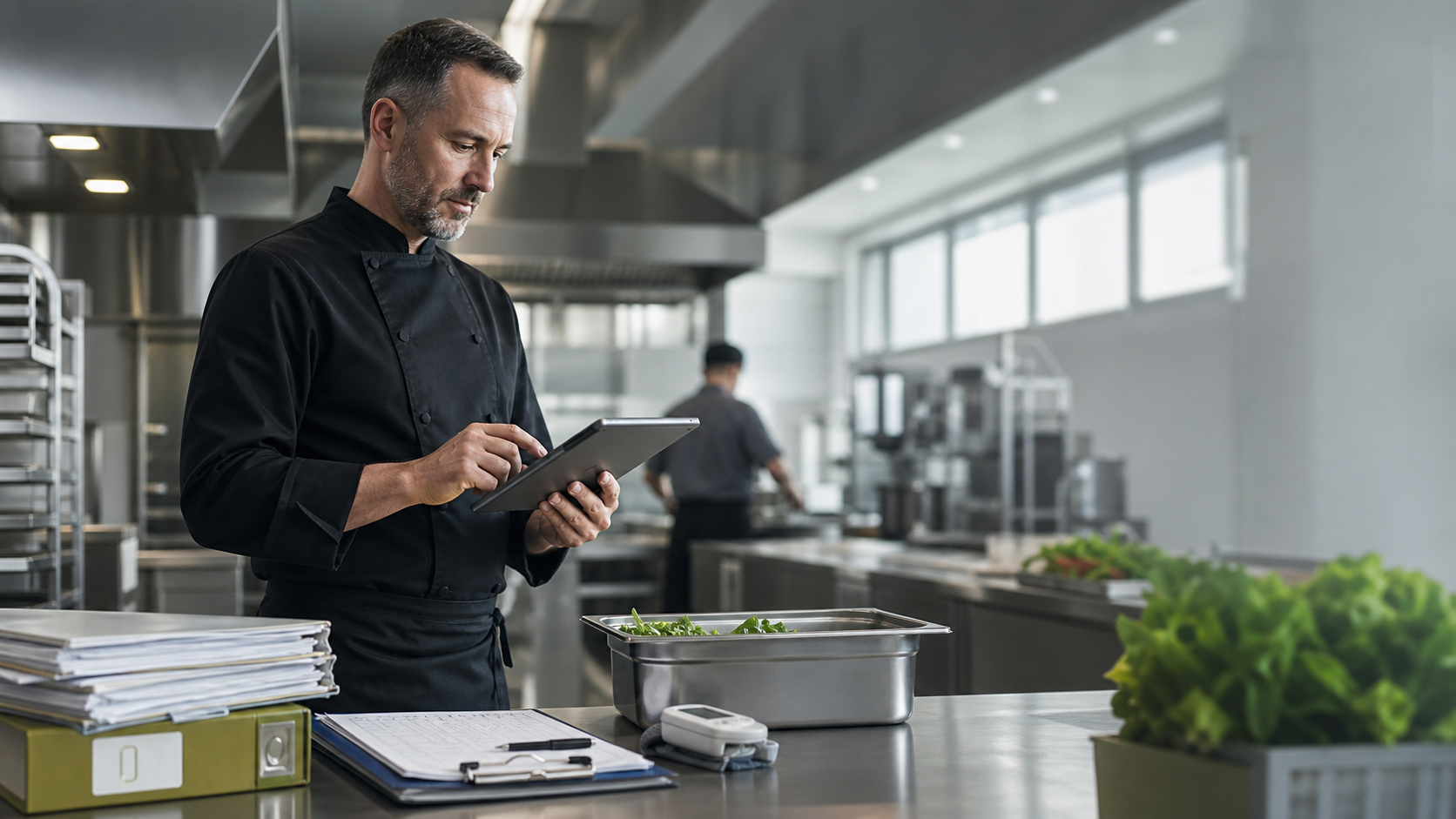
In many large kitchens, paper lists, Excel spreadsheets, and handwritten signatures are still the standard. In the hectic daily operations, systematic gaps inevitably arise: a measurement is forgotten, a cold storage unit is checked hours later, or a value is added from memory afterward. Anyone who has ever had to complete an unfinished list just before the end of a shift knows the problem. Such gaps often only become apparent during an inspection—when it’s too late to explain them properly.
Then there’s the sheer effort involved. Lists need to be printed, distributed, filled out, collected, and filed. Binders pile up, and in an emergency, someone spends minutes searching for proof of a specific day or device. With multiple locations or central kitchens, this effort multiplies because each site maintains its own paper archive, with no shared overview.
Paper is also inherently prone to errors. Handwriting isn’t always legible, lists get lost or damaged, and corrections are nearly impossible to trace. For a system designed to provide proof of food safety, this is a weak foundation—not due to negligence, but because the process doesn’t sufficiently support the people on the ground.
What a digital HACCP documentation actually improves
Digital HACCP documentation shifts recording from manual entries to structured inputs—and, where practical, to automated measurements. Instead of loose sheets of paper, a searchable database is created: every measurement is linked to the time, device, and responsible person. This noticeably reduces queries, as the answer to when something was checked is no longer searched for in a folder but displayed in seconds.
The second major advantage is completeness. A digital system can display due checks and remind employees of open tasks before a shift ends. This way, gaps become visible while they can still be closed. Values outside defined limits trigger an alert instead of going unnoticed until days later. This shifts the focus from retrospective control to ongoing quality assurance.
Finally, it creates transparency across locations. Management and quality teams can view the status of multiple kitchens in one place without needing to be on-site. A control center like Kibi Scada consolidates this information exemplarily in one location. The key here is not a single tool, but the principle: a centralized overview instead of scattered paper records.
The interplay between kitchen, quality management, and technology
HACCP isn’t the responsibility of a single person—it’s spread across multiple roles with different needs. In the kitchen, speed is key: recording must fit seamlessly into the workflow and not slow things down. The fewer steps an entry requires, the more reliably it will actually be done. A digital solution should focus on the essentials here.
Quality management, on the other hand, needs an overview and reliable evaluations. It defines checkpoints and limits, monitors compliance, and prepares documentation for audits. A shared database saves QM the hassle of gathering data from different sources and makes deviations detectable early. Instead of reconstructing events afterward, the status can be viewed continuously.
Finally, the technical team ensures that sensors, devices, and interfaces work reliably. A manufacturer-independent solution is advantageous here, as large kitchens rarely use equipment from just one brand. When refrigeration units, ovens, and dishwashers from different manufacturers feed into the same system, you avoid isolated solutions. Documentation works best when these three roles access the same data—rather than each maintaining their own lists.
Automatic temperature logging and threshold monitoring
Continuous temperature monitoring is one of the areas where digitalization makes the biggest difference. Sensors in refrigeration and freezer units record values at regular intervals—without anyone having to walk through the kitchen with a clipboard. This eliminates not just a repetitive task, but also creates a denser, more meaningful data set than individual spot checks per shift.
The key lies in clearly defined thresholds. If a range is exceeded—because a refrigeration unit door was left open too long or a device fails—the system can alert you early. This allows you to act before goods reach a critical state. This early warning is the real added value compared to mere recording: it prevents damage instead of just documenting it.
What remains important is that manual checks don’t disappear entirely. Certain inspections—such as core temperatures during serving—still require a conscious measurement by employees. A good solution combines both: automatic data collection where possible, and guided manual entries where necessary. This creates a realistic picture of operations instead of a purely technical ideal.
Audit readiness and a seamless chain of evidence
When food safety inspections take place, the value of thorough documentation becomes clear. What matters is not just individual, well-presented values, but a traceable chain: Who checked what and when, and what happened in case of deviations? A digital system can answer these questions precisely, as every entry is logged with a timestamp and accountability—and cannot be altered unnoticed.
How deviations are handled is especially critical. Passing an audit isn’t about nothing ever going wrong—that would be unrealistic—but about demonstrating that corrective action was taken. Digital documentation records when a limit was exceeded, what measures were implemented, and when the process was completed. These corrective actions are often where paper-based systems fall short.
For businesses with multiple locations, consistent structure is another advantage. When all kitchens document processes in the same way, evidence can be provided across sites in a comparable format. This speeds up audit preparation and reduces uncertainty about whether all records for a given day are truly complete. Audit readiness becomes less of a one-time effort and more of an ongoing state.
Common Pitfalls When Introducing a Platform
The biggest hurdle in transitioning is rarely the technology, but rather habit. Employees who have worked with clipboards and folders for years need a good reason—and some guidance—to make the switch. It’s proven effective to involve the team early and start with a manageable area rather than overhauling all processes at once. This way, quick, visible successes emerge that speak for themselves.
Another stumbling block is overly complex requirements. If a system has too many mandatory fields or unclear processes, employees under pressure will revert to sticky notes—and the gap is back. That’s why checkpoints and thresholds should be realistic and tailored to actual operations. It’s better to start with a lean, well-functioning setup and expand later than to try to map everything from the outset.
Finally, clear responsibilities are essential. Who maintains devices and sensors? Who responds to alarms outside core hours? Who conducts regular evaluations? If these questions are answered before implementation, documentation runs much smoother in daily operations. If left unaddressed, the former paper chaos simply shifts into a digital system—without the actual benefits.
What to look for in a solution
When choosing a digital HACCP solution, it’s worth taking a clear-eyed look at a few key criteria. For many large kitchens, vendor independence is a top priority because they work with a mixed equipment fleet and don’t want to be tied to a single brand. An open solution integrates devices from different manufacturers, avoiding new silos. Equally important is ease of use in daily kitchen operations—a system that only works at a desk is of little help on the line.
Also pay attention to reliable alerts, meaningful analytics, and the ability to provide audit evidence effortlessly. For multiple locations, a central overview is crucial so that management and quality teams don’t have to check each kitchen individually. When it comes to data, hosting in Germany and GDPR compliance matter—especially for sensitive operational data, this is a justified requirement, not a side note.
A control center like Kibi Scada consolidates monitoring, documentation, alerts, and reporting on a single platform. Ultimately, however, the name matters less than how well the solution fits your operations. Before making a decision, clarify your equipment, locations, and processes, and evaluate a solution against these exact points. This way, you avoid misinvestments and find a system that truly works in everyday use.
Conclusion
Digital HACCP documentation isn’t an end in itself—it’s a way to ease daily operations while creating more reliable records. Where paper creates gaps, extra effort, and uncertainty, a structured system ensures completeness, faster audits, and fewer follow-up questions. The biggest benefit lies in shifting from retrospective checks to continuous quality assurance.
The best way to get started is pragmatically: begin with a manageable area, involve the team, clarify responsibilities, and tailor the solution to real equipment and locations. A manufacturer-independent platform with hosting in Germany provides the necessary flexibility and data security. This turns a mandatory task into a reliable part of operations—keeping the central kitchen in full view, regardless of manufacturer or location.
Next step
Want to tackle this topic in your own operation?
We are happy to show you how temperature monitoring, HACCP documentation, reporting, food waste analysis or energy monitoring can be practically implemented in your kitchen structure.