
Understanding energy consumption in large kitchens: These systems cause the most expensive load peaks
Rising energy costs hit commercial kitchens hard. If you don’t clearly separate peak loads from continuous consumption, you often miss the biggest levers for savings.
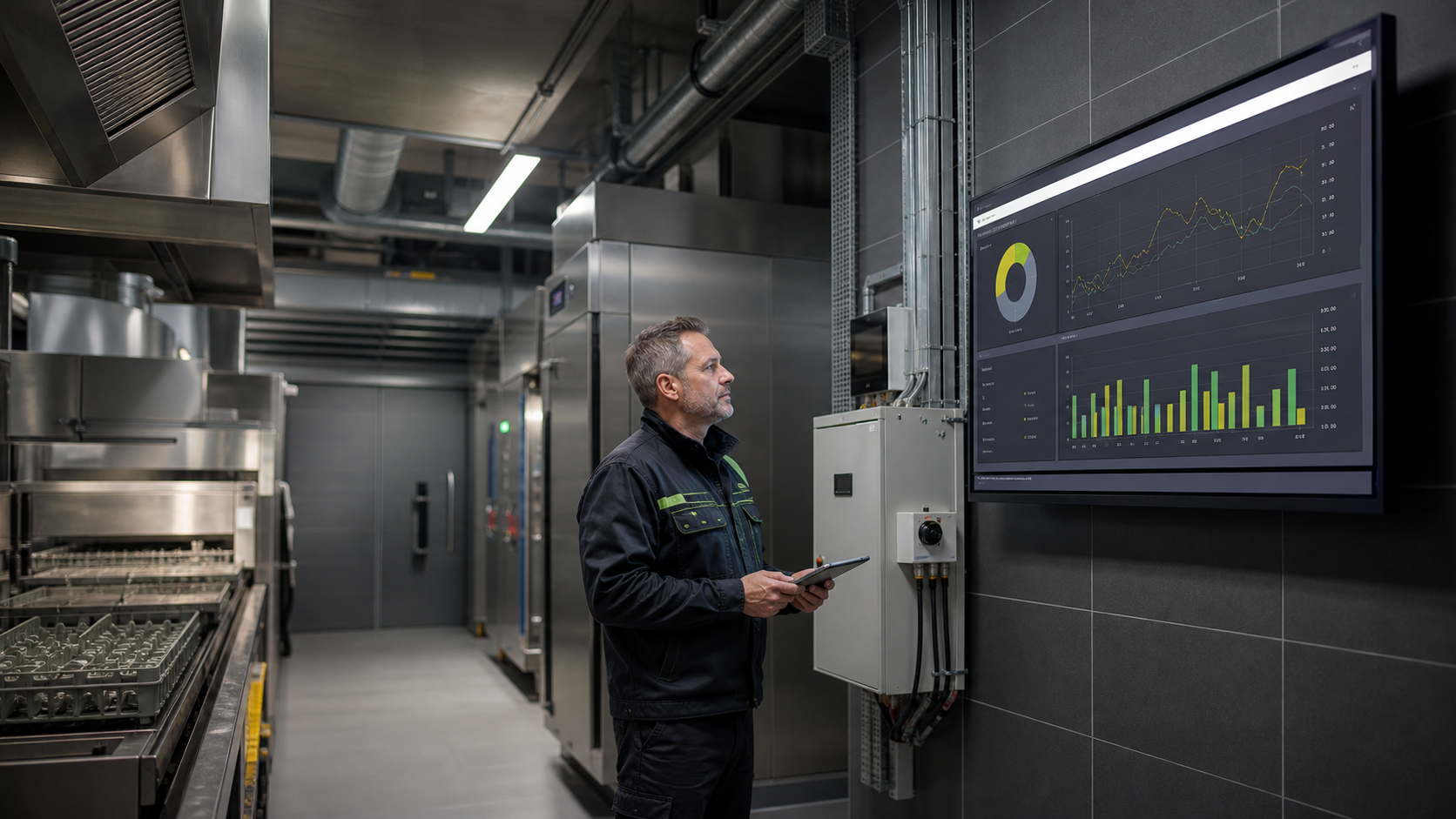

Why averages aren't enough
Energy costs in large kitchens can only be reduced effectively when it’s clear when and where energy is actually being used. A monthly average or annual consumption figure reveals little. Two operations with identical total consumption can have completely different cost structures because one distributes its load evenly throughout the day while the other concentrates everything into a few hours.
Averages smooth out precisely the moments that have the biggest impact on billing. Short, intense peaks in the morning—when ovens, dishwashers, and ventilation systems all start up at once—disappear in the daily average. If you only look at the total, you see the result but not the cause. Yet for informed decisions, you need the cause.
Only continuous measurement with time-based resolution reveals the actual load patterns your operation generates. This shows whether high consumption stems from a constant base demand or from a few avoidable peaks. This distinction is the foundation for any meaningful action.
Cleanly separate peak loads and base loads
The energy consumption of a large commercial kitchen is roughly divided into two components: a base load that runs more or less constantly, and peak loads that occur only at specific moments. Both components incur costs, but in different ways and with different levers. If you don’t separate them, you’re treating two distinct problems as one.
The base load is generated by everything that operates around the clock or over long periods: refrigeration, freezers, continuous ventilation, standby consumption. It’s unobtrusive but adds up significantly over days and weeks. Peak loads, on the other hand, occur when many systems start up simultaneously. Under many tariffs, this peak demand is charged separately, meaning just a few minutes can influence the price for an entire billing period.
This distinction leads to two separate tasks. For the base load, the goal is to reduce continuous consumption—through maintenance, seals, or adjusted operating times. For peaks, the focus is on staggering simultaneous start-ups. Both approaches are effective, but only if you know which component is truly driving costs.
Which systems typically consume a lot of energy?
In almost every large kitchen, certain equipment groups can be identified that regularly account for a significant portion of energy consumption. Refrigeration and freezer systems run continuously and are sensitive to door openings, worn seals, or high ambient temperatures. They form part of the base load and are often overlooked precisely because they don’t stand out with visible peaks.
Regeneration and cooking processes, such as in combi steamers or when heating large quantities, typically generate load peaks. These occur in concentrated bursts before serving times and often overlap with the start-up of dishwashing equipment. Dishwashers with heated tanks and the associated hot water preparation are also among the high-consumption areas, especially during peak times after meals.
Additionally, ventilation and air conditioning systems often run continuously, along with the prolonged warming of prepared meals. Which of these systems has the greatest impact in a specific operation cannot be generalized. This is precisely where the value of precise equipment-level measurement lies: it replaces assumptions with reliable data.
Where the biggest levers are often hidden
The biggest savings opportunities are rarely where you first suspect them. Attention often focuses on individual, visible high-consumption devices, while the real leverage lies in timing coordination. When several energy-intensive systems habitually start at the same minute, a peak occurs that can be significantly reduced through staggered start-up scheduling—without affecting kitchen operations.
A second, often underestimated lever is consumption outside production hours. Systems that continue running at night, on weekends, or during breaks—without being needed—go unnoticed in daily operations. In load profiles, however, such silent consumption becomes immediately visible, for example as a flat baseline that never drops to zero, even when operations are idle.
Third, it’s worth looking at gradual changes. A cooling system slowly becoming less efficient or a device running differently after maintenance alters the profile incrementally. Such changes are only detectable through historical comparisons. With access to past trends, you can spot deviations before they show up in the annual bill.
Making locations and production lines comparable
When an organization operates multiple kitchens or production lines, an additional, valuable reference point emerges: the comparison between them. Two comparable locations with similar equipment and output should also show similar load patterns. If they don’t, the deviation itself is the most important information. It indicates a system, setting, or practice that differs from the other.
Such comparisons only work when data is consolidated across locations on a shared platform. If consumption is viewed in isolation per location, there’s no benchmark for what’s normal and what’s not. A central, manufacturer-independent evaluation creates a common foundation, allowing operations to be fairly and transparently compared side by side.
This comparison also drives a learning effect across the entire organization. The location with the most efficient load pattern provides a practical example of how processes can be structured. This makes good solutions visible and transferable, rather than each operation optimizing in isolation.
How energy monitoring becomes operationally actionable
Data alone doesn’t cut costs. What matters is that insights from monitoring reach the kitchen’s daily operations and translate into concrete actions. For this to happen, evaluations must be clearly prepared and reach the people who actually decide on runtime, start-up sequences, and maintenance. A chart that no one interprets remains ineffective.
The real value lies in connecting technology and operations. When an unusual base load or an unusual trend is reported promptly, the team can check whether a door is left open, a device was forgotten, or a system needs maintenance. This turns passive measurement into an operational alert that reaches the right people at the right time. A platform like Kibi Scada consolidates such trends and alerts in one place.
For lasting impact, energy monitoring should become a fixed part of the routine—not a one-time effort. Regular reviews of trends, clear responsibilities, and a simple way to document anomalies ensure that improvements once achieved are maintained. Keeping energy in central focus is less a project and more an ongoing practice.
Energy as Part of Sustainability and Reporting
Conscious energy management is far more than just a cost issue. For many businesses in the catering industry, documenting consumption is also becoming relevant for sustainability goals and reporting obligations. Those who continuously record their load profiles have reliable data at hand—no need to scramble for figures at the end of the year.
Structured reporting makes changes over time traceable. It shows whether implemented measures are having an impact and provides a factual basis for discussions with management, auditors, or customers. This traceability is also important because it makes statements about your own energy use verifiable, rather than relying on estimates.
Energy management thus follows the same logic that already applies to HACCP and hygiene in large kitchens: measure continuously, document accurately, and keep track. Businesses that have already established these routines can integrate energy monitoring into their existing documentation practices with minimal extra effort.
Conclusion
Rising energy costs hit commercial kitchens hard, but the path to savings isn’t about blanket targets—it’s about understanding. Only by separating base load from peak loads and analyzing consumption at the equipment level can you see where the real levers are—and replace assumptions with reliable data.
The biggest opportunities often lie in coordinating simultaneous start-ups, eliminating hidden consumption outside production hours, and spotting gradual changes that only become visible over time. When data is consolidated across locations, shared with the right people, and embedded into daily routines, monitoring becomes an operationally effective tool—one that also lays the foundation for sustainability and reporting.
Next step
Want to tackle this topic in your own operation?
We are happy to show you how temperature monitoring, HACCP documentation, reporting, food waste analysis or energy monitoring can be practically implemented in your kitchen structure.